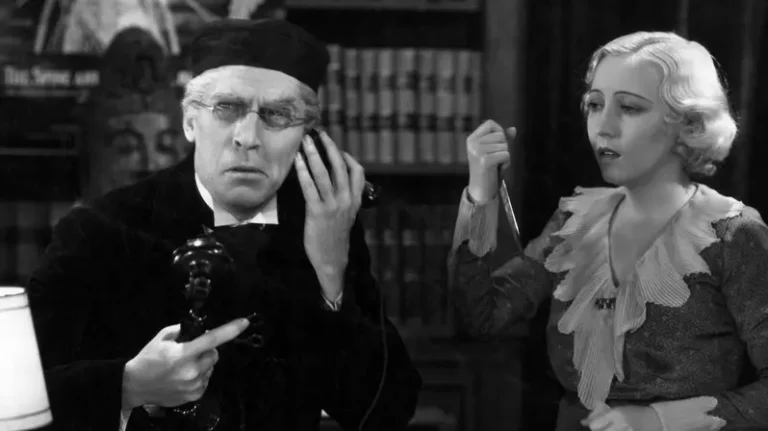
Scarlet Street (1945): Fritz Lang’s Bleak Film Noir Masterpiece
You’re sitting there, thinking you’re smart. You think you can spot a con from a mile away. You have a stable job, a quiet life, maybe a hobby that keeps you sane. Then you watch Fritz Lang’s Scarlet Street (1945), and you realize that if a beautiful woman smiled at you in the rain, you’d gladly embezzle your life savings, ruin your reputation, and hand her the knife to stab you in the back.
The Setup
One pathetic, middle-aged cashier. One manipulative femme fatale. Her sleazy, abusive boyfriend.
That’s it. That’s the whole script.
Lang introduces us to Christopher Cross, a meek cashier who has spent twenty-five miserable years married to a shrewish widow who openly despises him. His only escape is painting. One night, he rescues Kitty March from an apparent assault by Johnny Prince. Mistaking Chris’s modest demeanor for the eccentricity of a wealthy, world-class artist, Kitty and Johnny hatch a plan to bleed him dry. Chris, desperate for a shred of affection, falls hopelessly in love and begins stealing from his employer to fund Kitty’s luxurious apartment—unaware that she is feeding his money, and his heart, straight to her abusive boyfriend.
The Experience
There is no hope. There is only a slow, agonizing slide into a psychological abyss. Fritz Lang’s direction is cold, clinical, and utterly merciless. Edward G. Robinson gives a masterclass in pathetic vulnerability; his transition from a gentle, hopeful romantic to a hollow shell of a man is agonizing to watch. Joan Bennett’s Kitty is a terrifyingly realistic femme fatale—not a glamorous mastermind, but a lazy, cruel, and cheap opportunist.
It’s 103 minutes of pure, undiluted fatalism. It takes the classic noir trope of the seduced man and turns it into a slow-motion car crash of human dignity. The most devastating part is the paintings. When a gallery discovers Chris’s art, Johnny and Kitty sell them under Kitty’s name. Chris is so desperately eager to please her that he happily lets her take credit for his soul. When the inevitable betrayal occurs, it doesn’t lead to a clean, dramatic climax. It leads to a messy, violent tragedy where the wrong person pays, and Chris is left to rot in a self-made purgatory of guilt and madness, completely ignored by a world that finds him too pathetic to even arrest.
Why You’ll Watch
You’ll watch because you need a reminder of how easily loneliness can be weaponized against us.
Lang didn’t just make a crime thriller; he made a terrifyingly honest study of human desperation. It is arguably the bleakest film noir ever made, showing a world where justice is blind, love is a transactional scam, and the worst punishment is having to live with yourself. By the time the final, haunting frames fade to black, you won’t look at relationships the same way. You’ll look at your own desperate need for validation, you’ll look at the rain-slicked streets, and you’ll wonder how much you would sacrifice just to feel seen.
Rating: 5 out of 5 stolen oil paintings.
Watch Scarlet Street on YouTube:
About the Author