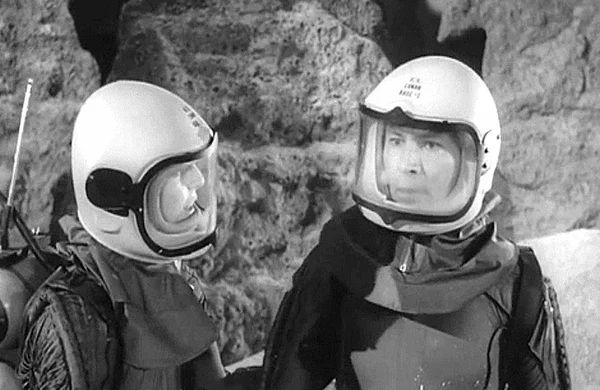
You’re sitting there, thinking you’re a modern space explorer. You dream of Mars, you play high-tech video games, and you think space is a grand, silent expanse of physics. Then you watch William Marshall’s The Phantom Planet (1961), and you realize that if you ever actually get lost in the cosmos, you’ll probably just get shrunk to the size of an action figure and forced to referee a love triangle between two telepathic alien women in short skirts.
The Setup
One stoic astronaut. A mysterious, invisible asteroid. A race of six-inch-tall humanoid pacifists and a giant, grunting monster in a rubber suit.
That’s it. That’s the whole script.
Marshall drops us into the far-off “future” of 1980. Captain Frank Chapman is piloting a rocket ship when a meteor shower damages his vessel, forcing him to make an emergency landing on the invisible asteroid Rheton. But Rheton isn’t just rock; it’s home to a tiny civilization. The moment Chapman steps out, the asteroid’s unique atmosphere shrinks him down to their miniature size. He is instantly captured, put on trial, and then—in true B-movie fashion—welcomed with open arms once they realize he isn’t a threat.
The Experience
There is dialogue, and most of it sounds like it was written by a middle-schooler who just discovered the word “atmosphere.” The film is a glorious, low-budget parade of cardboard spaceships, zero-gravity walks simulated by hanging actors from visible wires, and sets that look suspiciously like paper-mâché caves. The citizens of Rheton are under constant threat from the “Solarites”—hideous, fire-breathing rock monsters that look like a dog-faced sleep paralysis demon wearing a burlap sack.
It’s 82 minutes of pure, unadulterated retro-futuristic cheese. It takes a premise that should be a terrifying existential nightmare—being permanently miniaturized on a drifting rock in the dead of space—and turns it into a bizarre high school drama. Chapman doesn’t spend his time panicking about his survival; instead, he gets caught in a romantic rivalry between the ruler’s mute daughter and a jealous alien noble. The climax isn’t a grand space battle; it’s Chapman throwing rocks at a rubber monster that is actively overheating under the studio lights.
Why You’ll Watch
You’ll watch because sometimes you need a break from high-concept, multi-million-dollar CGI blockbusters to appreciate the raw, earnest silliness of 1960s science fiction.
Marshall didn’t make a cinematic masterpiece; he made a perfect Saturday morning time capsule. It is aggressively cheap, spectacularly acted with absolute gravity, and remains one of the most delightfully mockable space movies of its era. It’s a B-movie gut-punch of nostalgic joy. By the time Chapman finally figures out how to get back to his normal size, you won’t look at space exploration the same way. You’ll look at the stars, you’ll look at your old toy action figures, and you’ll wonder if they’re plotting a coup.
Rating: 3 out of 5 visible suspension wires.
Watch The Phantom Planet (1961) on YouTube