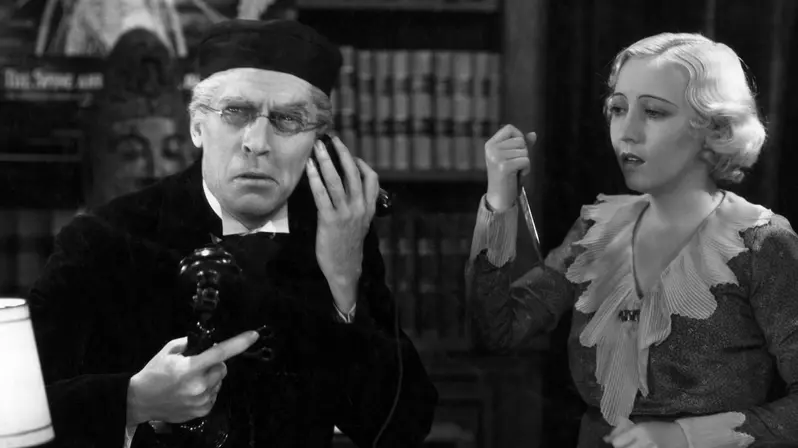
You’re sitting there, thinking you have a tight grip on reality. You think you understand justice. You think if you committed a crime, you’d turn yourself in, or at least run somewhere sensible. Then you watch Christy Cabanne’s Conspiracy (1930), and you realize that if you stabbed a drug kingpin to death in a frantic pre-Code scuffle, your best bet at survival would be hiding out in a women’s shelter with a cynical, deadpan mystery writer who treats real-life murder like a crossword puzzle.
The Setup
One vengeful sister on the lam. A kidnapped assistant D.A. brother. An eccentric, grumpy crime novelist who wants to crack the case for his next book.
That’s it. That’s the whole script.
Cabanne drags us into the gritty, early talkie underworld of the dawn of the 1930s. Margaret Holt has spent years trying to help her brother, Victor, bring down the “Schemer Marko” narcotics ring responsible for their father’s death. She goes undercover as the gang leader’s secretary, but when she’s discovered, things go violently sideways. Margaret kills the mob boss in a frantic struggle and runs for her life, terrified of a murder charge. On the run, she crosses paths with an eager reporter and Winthrop Clavering—a hilariously cynical, grumpy mystery writer who decides that instead of turning her in, he’s going to use her actual, terrifying plight to plot his next best-selling novel and bust the drug ring himself.
The Experience
There is a lot of frantic, early-sound dialogue, clunky microphones, and the unmistakable, razor-sharp deadpan of Ned Sparks. Sparks practically walks away with the entire movie, delivering dry, cynical, politically incorrect cuts while treating a real-life murder investigation with the casual amusement of a man playing solitaire. Bessie Love brings her silent-era emotional intensity to the role of Margaret, wide-eyed and genuinely terrified as the walls of both the police and the syndicate start closing in on her.
It’s 69 minutes of pure, unpolished pre-Code chaos. It takes a heavy crime drama about the drug trade and violently collides it with drawing-room comedy. The film captures that bizarre transition era of early Hollywood where directors were still figuring out how to make sound work, giving the movie a strange, jittery, and raw energy. The climax is a convoluted, theatrical trap engineered by a novelist who thinks he can out-think real-world gangsters—and somehow, in the ridiculous logic of 1930 cinema, it works.
Why You’ll Watch
You’ll watch because you want a front-row seat to the wild, lawless frontier of early pre-Code Hollywood before the censors cleaned up the screens.
Cabanne didn’t direct a polished, prestige picture; he captured a gritty, experimental slice of early talkie melodrama. It is atmospheric, occasionally bizarre, and filled with the kind of dark humor and rough edges you can only find in 1930. It’s a fast-moving, compact gut-punch of vintage crime. By the time the final credits roll and the drug ring is smashed, you won’t look at crime fiction the same way. You’ll look at the nearest grumbling cynic, you’ll look at your own secrets, and you’ll wonder who is plotting the next move.
Rating: 3.5 out of 5 deadpan cynics.
