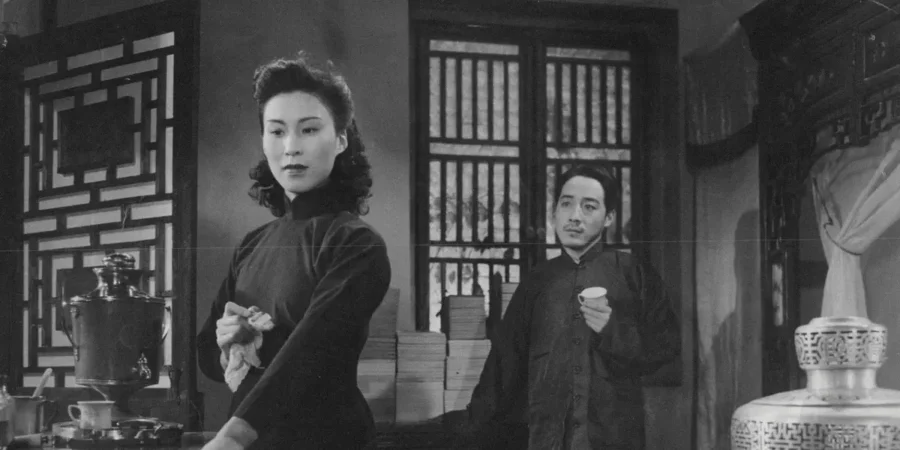
Early Chinese cinema—spanning the silent era of the 1920s, the turbulent Republican era of the 1930s, and the post-war transition of the late 1940s—is one of the most vibrant and historically significant chapters in global film history. Centered in the cosmopolitan hub of Shanghai, early Chinese filmmakers did not merely copy Western cinematic models; instead, they forged a distinct visual language. They seamlessly fused traditional Chinese aesthetic forms—such as shadow puppetry, operatic theater, paper-cutting, and classical ink painting—with cutting-edge global trends like German Expressionism, Hollywood screwball comedy, and Soviet montage. These films served as mirrors to a society grappling with rapid modernization, colonial presence, class struggle, and wartime devastation.
Because of the passage of time and the unique structure of Chinese copyright laws, many of these foundational classics are now in the public domain. For global cinephiles, the availability of these works offers an invaluable opportunity to explore a goldmine of genre-defying, socially conscious storytelling. From gothic horror-musicals to pioneering animation and sharp domestic satires, the following films represent essential viewing for any serious lover of cinema.
1. Street Angels 馬路天使 (1937)
Street Angels stands as one of the defining masterpieces of China’s pre-war leftist cinema. Directed by Yuan Muzhi, the film is a deeply empathetic tragicomedy that chronicles the daily struggles of Shanghai’s urban underclass. It follows a young, displaced songstress (played by the legendary Zhou Xuan) and her trumpet-player boyfriend (Zhao Dan) as they try to navigate poverty, exploitation, and the threat of forced prostitution in the city’s slums.
What makes the film a cinephile’s delight is its brilliant tonal balancing act. Yuan Muzhi masterfully juxtaposes lighthearted, slapstick romance with unsparing social realism. The film is also historically prized for its music, featuring two iconic, melancholic ballads sung by Zhou Xuan—”Song of the Four Seasons” and “The Wandering Songstress”—which became timeless classics of Chinese popular culture. Rather than offering a tidy Hollywood resolution, Street Angels concludes with a stark, sobering reminder of class inequality, cementing its place as a landmark of critical realism.
2. Crows and Sparrows 烏鴉與麻雀 (1949)
Filmed in secret during the final, chaotic months of the Chinese Civil War, Crows and Sparrows is a masterclass in domestic spatial allegory. The narrative is confined entirely to a single Shanghai apartment building, serving as a microcosm of Chinese society on the eve of political transition. The “sparrows” are a diverse group of middle- and lower-class tenants who must band together to resist eviction by the “crow”—a corrupt, predatory Nationalist official and his mistress who are trying to sell the building before fleeing the country.
Directed by Zheng Junli, the film crackles with a tense, claustrophobic energy, capturing the real-life anxieties of hyperinflation and political collapse that gripped Shanghai in 1949. Its brilliant ensemble cast delivers sharp, satirical performances that highlight the moral compromises of survival. By utilizing the shared spaces of the apartment building to engineer conflict and solidarity, the film established a narrative blueprint that heavily influenced later Hong Kong and mainland domestic dramas.
3. Song at Midnight 夜半歌聲 (1937)
Widely recognized as China’s first true horror film, Song at Midnight is a wildly creative adaptation of Gaston Leroux’s The Phantom of the Opera. Directed by Ma-Xu Weibang, the film transposes the classic story to a dilapidated theater in China, where an old, scarred revolutionary named Song Danping hides in the shadows, helping a struggling theater troupe from behind the scenes.
Ma-Xu Weibang draws heavily on German Expressionism, utilizing dramatic shadows, Dutch angles, and gothic architecture to craft a beautifully spooky atmosphere[8]. However, the film subverts Western horror conventions by reframing the “monster” as an innocent, sympathetic victim of political corruption and feudal violence rather than an obsessive villain. Melding gothic horror, political melodrama, and operatic musical numbers, this film remains a hauntingly unique piece of pre-war cinema.
4. City Scenes 都市風光 (1935)
Yuan Muzhi’s directorial debut, City Scenes (also known as Scenes of City Life), is an ambitious “city symphony” and social farce that satirizes the dazzling, deceptive allure of 1930s Shanghai. The story revolves around a love triangle involving a naive intellectual, a materialistic young woman, and a series of city slickers, illustrating how the capitalist metropolis seduces and corrupts those who enter it.
The film is celebrated for its highly experimental, avant-garde techniques. Yuan utilizes kinetic editing, split screens, and an innovative musical score to mimic the sensory overload of modern urban life. Film historians also prize City Scenes for its rare cartoon insert created by the Wan brothers, as well as a brief supporting appearance by a young actress named Lan Ping, who would later achieve historical infamy as Jiang Qing (Madame Mao).
5. Princess Iron Fan 鐵扇公主 (1941)
Created under the grueling conditions of Japanese-occupied Shanghai during World War II, Princess Iron Fan is a monumental achievement as the first full-length animated feature film in Chinese and Asian cinema history. Directed by the pioneering Wan brothers, the film adapts a famous episode from the classic novel Journey to the West, wherein the Monkey King (Sun Wukong) and his companions must acquire a magical fan from a stubborn princess to extinguish a raging wall of fire.
The animation style is a fascinating cross-pollination of Disney-inspired fluid rotoscoping and traditional Chinese ink-and-wash paintings. Beyond its technical wonders, the film was a thinly veiled patriotic allegory. The narrative of a community banding together to defeat a powerful demon served as a call for Chinese citizens to unite and overcome the fiery trials of foreign occupation. It was so influential that it famously inspired a young Osamu Tezuka to dedicate his life to creating Japanese animation (anime).
6. Wanderings of Three Hairs the Orphan 三毛流浪記 (1949)
Based on Zhang Leping’s beloved, heartbreaking comic strip, this live-action tragicomedy follows Sanmao, a homeless street urchin with only three hairs on his head, as he attempts to survive in the unequal, hostile streets of Shanghai. The film utilizes physical comedy and slapstick humor to tell a story that is, at its core, a devastating indictment of social apathy and systemic neglect.
Directors Zhao Ming and Yan Gong brilliantly bring the visual language of the comic strip to life, giving Sanmao’s character cartoonish features and expressions while placing him in real, gritty Shanghai locations. The film is a fascinating historical artifact; because it was completed right as the People’s Liberation Army entered Shanghai, the filmmakers tacked on real documentary footage of the victory parade at the end. This hybrid of cartoon slapstick and historical reality makes it a deeply moving experience.
7. Pigsy Eats a Watermelon 豬八戒吃西瓜 (1958)
Directed by Wan Guchan, Pigsy Eats a Watermelon is a milestone in Chinese animation history, representing the birth of the “cut-paper” (jianzhi) animation technique. This short film takes another playful spin-off from Journey to the West, centering on the gluttonous, lazy character Pigsy (Zhu Bajie). While his companions search for food, Pigsy finds a massive watermelon, succumbs to his desires, and eats the entire fruit himself, only to be humorously punished by the clever Monkey King.
The film is visually breathtaking, translating the vibrant, intricate aesthetics of traditional Chinese paper-cutting folk art into a fluid, stop-motion medium. However, for the historical-minded cinephile, the film holds a poignant layer of irony: this charming, moralistic short film about the perils of greed, hunger, and food hoarding was released in November 1958—precisely as China was entering the catastrophic shortages of the Great Famine.
