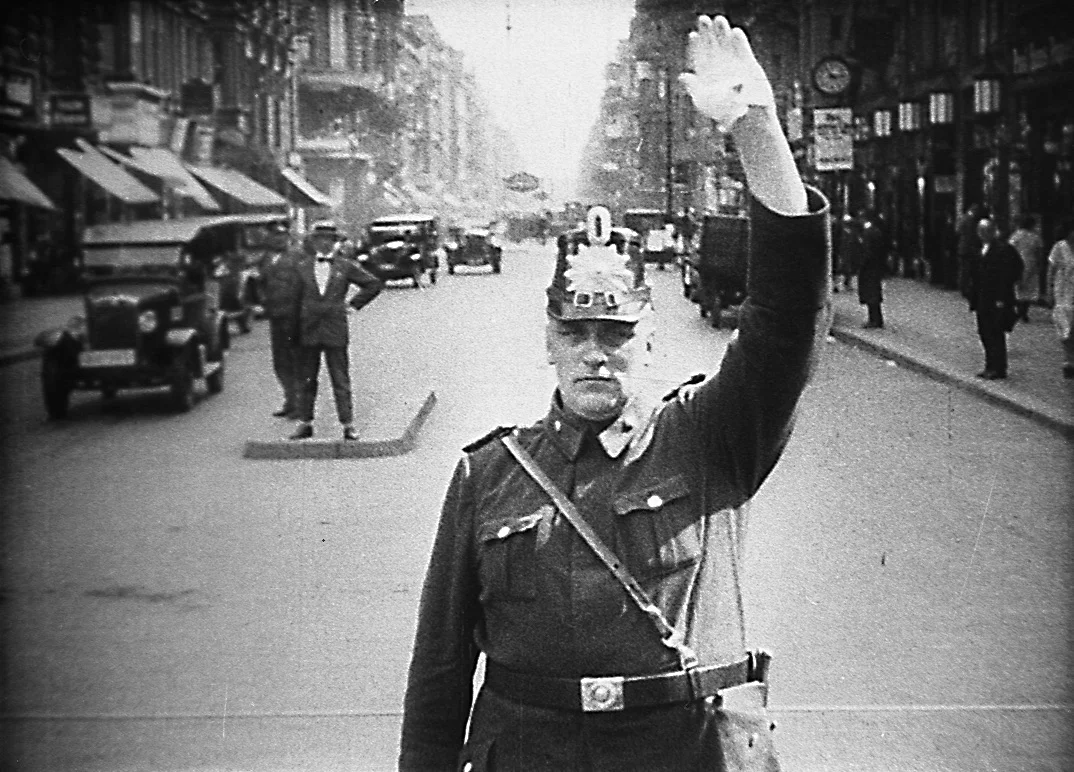
How to Spy on Weimar-Era Citizens with a Suitcase Camera, Orchestrate a City’s Pulse, and Step into a Melancholic Time Machine
It’s 3:15 AM. My eyes feel like they’ve been rubbed with coarse sandpaper, the cold pizza on my desk is starting to look back at me, and I am currently watching a hypnotic, rapid-fire montage of turning train wheels, spinning factory gears, flowing milk bottles, and bustling crowds of Weimar-era Berliners, all moving in perfect, rhythmic synchronization to a booming orchestral beat.
Welcome, my friends, to the dazzling, machine-age, and historically haunting world of the “City Symphony.”
If you’ve never watched Berlin: Symphony of a Great City (Berlin: Die Sinfonie der Großstadt), congratulations: you’ve never experienced a documentary that treats a massive, industrial metropolis not as a collection of buildings, but as a living, breathing, and dancing organism. The director, Walter Ruttmann, and his brilliant crew had a simple, highly artistic, and incredibly stealthy strategy:
- Ditch traditional actors, scripts, and narrative plots entirely, and let the editing (montage) create a “symphony” of visual rhythms.
- Hire legendary cinematographer Karl Freund (the genius who shot Metropolis and Dracula) to build a hidden camera setup so you can film real, unsuspecting citizens without them realizing they are on camera.
- Capture the entire, glorious 24-hour cycle of Berlin—from a quiet, sleeping dawn to a neon-soaked, jazz-fueled cabaret midnight.
The result? Berlin: Symphony of a Great City (1927).
The “Plot” (If we can even call it that)
There is no plot. The film is structured in five acts, representing a single day in Berlin in the late 1920s.
Act I begins at dawn, with a train steaming through the empty suburbs and into a quiet, sleeping city. Act II shows the city waking up—shutters opening, streets being swept, and thousands of workers pouring into factories as massive gears begin to spin. Act III dive-bombs into the chaotic, mid-day rush of businessmen, telephones, and streetcars. Act IV shows the afternoon lull—people eating lunch, dogs resting, and kids playing. Finally, Act V explodes into the roaring, neon-lit Berlin nightlife, packed with jazz clubs, cabaret dancers, boxing matches, and spinning roulette wheels.
It is a non-stop, 65-minute sensory overload of motion, machinery, and human life.
Why You Need to Watch This Tonight
- The Ultimate, Melancholic Time Machine: This movie is a beautiful, haunting, and incredibly poignant historical document. It shows Berlin at the absolute peak of its Weimar-era cultural, industrial, and social freedom. The city is thriving, modern, and alive. But because we know what is coming in the 1930s and 40s—the Great Depression, the rise of the Nazi regime, and the near-total destruction of this very city in World War II—watching these happy, bustling Berliners going about their daily lives carries a heavy, heartbreaking retroactive melancholy.
- The Secret Suitcase Camera: In 1927, movie cameras were massive, heavy, and incredibly obvious. If Karl Freund had set up a tripod on a Berlin street, people would have stopped, stared, and posed, ruining the raw reality of the shots. To get around this, Freund hid his camera inside a suitcase, cut a tiny hole for the lens, and walked around the city like a spy, capturing genuine, un-staged human moments.
- The Rhythmic Editing (Montage): Walter Ruttmann edited the film like a musical composer. He cuts between spinning gears, typing fingers, marching feet, and rotating doors with such precise, rhythmic timing that the machines and the people merge into a single, unified dance. It is the grandfather of modern music video editing.
- The Edmund Meisel Score: The original score was custom-composed by Meisel to be perfectly, mathematically synchronized with the film’s edits. The music doesn’t just play in the background—it chugs like a train, clangs like a factory, and swings like a jazz club, turning the silent film into a true, multimedia masterpiece.
The Verdict
Is it a good movie? It is an absolute masterpiece of avant-garde cinema. It is hypnotic, visually stunning, and historically massive. At just 65 minutes long, it is the perfect late-night watch for when you want to turn off your brain’s logic centers, turn up your speakers, and let a beautiful, lost world wash over you.
My Rating: 5 out of 5 hidden camera lenses disguised as ordinary luggage.
Wanna see a legendary Weimar-era city symphony for free?
Turn off your phone, dim the lights, and search for this German silent classic on your favorite retro cinema or archive platform. Because it was made nearly a century ago, the entire film is in the public domain, meaning you can step into 1927 Berlin completely free and legally.