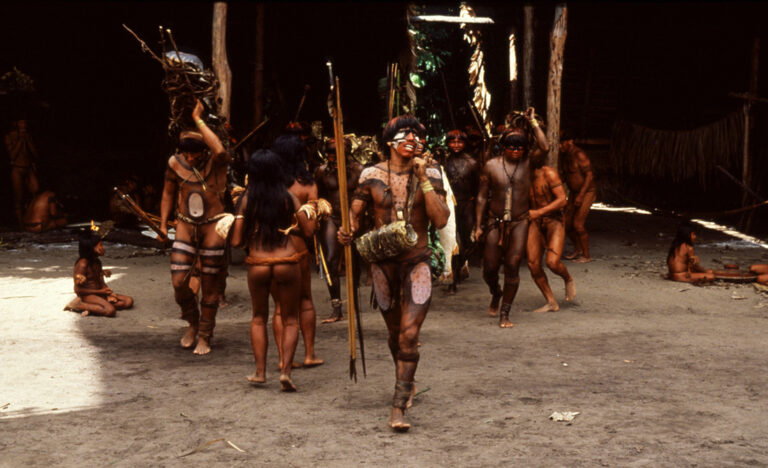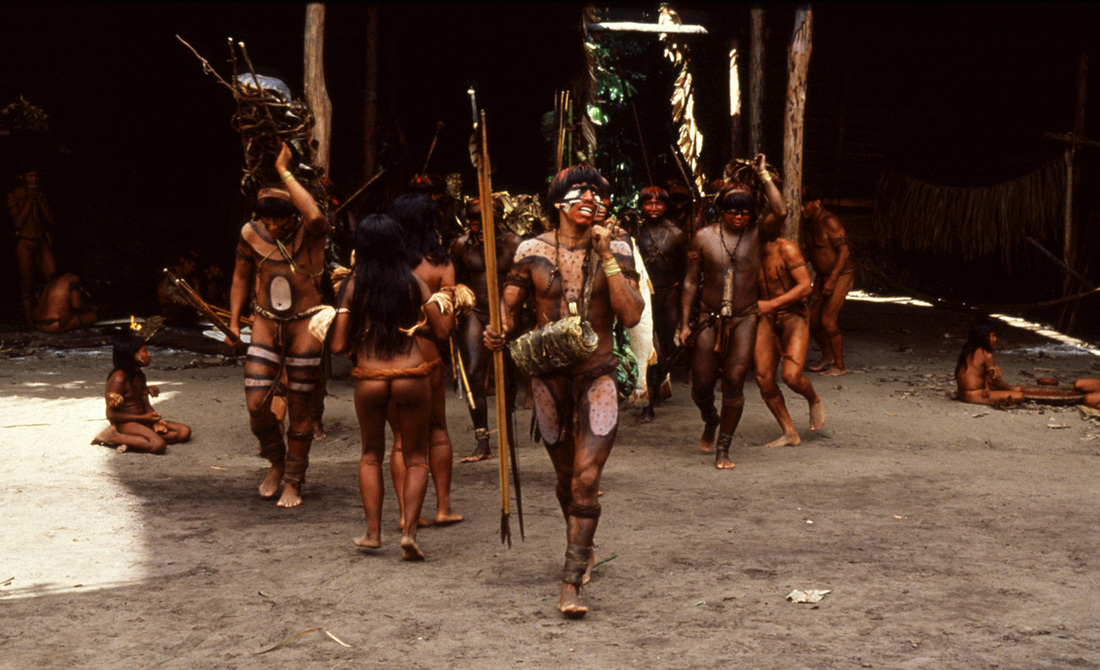
To the endless frustration of dedicated archivists and cinephiles alike, Héctor Babenco’s At Play in the Fields of the Lord has practically vanished into the cinematic ether. Tracking down a high-quality version of this film today feels like mounting your own Herzogian expedition into the uncharted Amazon.
In the remote reaches of the Amazon rainforest, a clash of ideologies unfolds when two disparate groups of Americans arrive with devastating intentions for the uncontacted Niaruna tribe. While a pair of fundamentalist Christian missionaries attempts to “save” the Indigenous people through spiritual colonization, two cynical, stranded bush pilots are hired by a corrupt local official to bomb the tribe’s village from the sky. The situation descends into chaos when one of the pilots, a disenfranchised part-Native American man, experiences a profound spiritual crisis and parachutes into the jungle to live among the very people he was paid to destroy. What follows is a tragic, visually sweeping exploration of cultural imperialism, existential madness, and the apocalyptic consequences of Western intervention.
To engage with Héctor Babenco’s sweeping adaptation of Peter Matthiessen’s novel, At Play in the Fields of the Lord (1991), is to wade into the murky, humid depths of a cinematic epoch when Hollywood was still willing to finance sprawling, morally complex ethnographic epics. Arriving on the heels of Kevin Costner’s romanticized Dances with Wolves, Babenco’s three-hour opus offers a far more corrosive, cynical antidote to the “white savior” narrative. It is a piece of ambitious film magisterium that dissects the arrogance of Western expansionism. Through a rigorous, unsentimental lens, the film orchestrates a devastating collision between indigenous purity, militaristic capitalism, and the suffocating neuroses of evangelical Christianity, cementing its place as a profound, if overlooked, masterpiece of 1990s cinema.
The Shadow of Herzog and the Jungle as a Crucible
Any cinematic venture into the Amazon inevitably invites comparison to the fever-dream expeditions of Werner Herzog, and Babenco leans into this environmental dread with remarkable visual poetry. However, where Herzog’s Aguirre, the Wrath of God and Fitzcarraldo treat the jungle as a canvas for European megalomania, Babenco frames the rainforest as a profoundly indifferent, ancient organism. Captured through the breathtaking, sun-dappled cinematography of Lauro Escorel, the Amazon is both a terrestrial paradise and a claustrophobic purgatory that actively accelerates the psychic decay of the Western interlopers.
The visual syntax of the film owes much to the immersive, tactile environments of Terrence Malick or the river-bound descent of Francis Ford Coppola’s Apocalypse Now. The heat is almost palpable on the celluloid; sweat stains the collars of the missionaries, and the oppressive humidity seems to warp the very fabric of their convictions. Babenco uses the sprawling canopy not merely as a backdrop, but as a silent, monolithic judge, observing the pathetic squabbles of men who mistakenly believe they can tame an ecosystem that has thrived for millennia without their intervention.
The Hubris of the Cross and the Cult of Assimilation
The ideological battleground of At Play in the Fields of the Lord is primarily occupied by the two missionary couples, played with agonizing fragility and neurotic intensity by Aidan Quinn, Kathy Bates, John Lithgow, and Daryl Hannah. If Roland Joffé’s The Mission romanticized the Jesuit pursuit of spiritual defense, Babenco completely strips away the martyrdom of the cloth. Here, the Protestant missionaries are depicted not as holy saviors, but as deeply flawed, sexually repressed individuals projecting their own existential terror onto the tabula rasa of the Niaruna people.
Lithgow’s portrayal of Leslie Huben is a masterclass in passive-aggressive zealotry, embodying the sheer arrogance of cultural erasure masked as divine love. The film’s critique of religious imperialism is scalpel-sharp: the missionaries do not wish to understand the Niaruna; they wish to dress them in Western clothes, strip them of their myths, and cure them of their inherent wildness. Babenco frames their outpost as a tragicomic, alien settlement—a stark visual anomaly against the primal backdrop. Their eventual unraveling, brought on by disease, doubt, and the sheer hostility of the environment, serves as a searing indictment of the belief that the Western moral compass is universally applicable.
Moon’s Descent and the Heart of Darkness
At the narrative fulcrum of the film is Lewis Moon (Tom Berenger), a mercenary pilot of Cheyenne descent whose trajectory provides the film’s most complex structural arc. Moon is a man hollowed out by the historical trauma of his own people, drowning his identity in cheap liquor alongside his partner Wolf (a gloriously gritty Tom Waits). When Moon ingests a potent indigenous hallucinogen and subsequently flies his plane into the heart of the jungle to join the Niaruna, he embarks on a Joseph Conrad-esque journey into the heart of darkness.
However, Babenco brilliantly subverts the traditional cinematic catharsis of the outsider “going native.” Moon’s integration into the Niaruna society is fraught with tragic irony. He attempts to play god to save them from the missionaries and the military, but ultimately realizes that his very presence is the contagion that seals their doom. Like a biological manifestation of original sin, the West brings disease—both spiritual and physical—that cannot be outrun. At Play in the Fields of the Lord concludes on a note of devastating fatalism, serving as a monumental cinematic elegy for the indigenous worlds crushed beneath the relentless, unyielding wheels of “civilization.”
About the Author