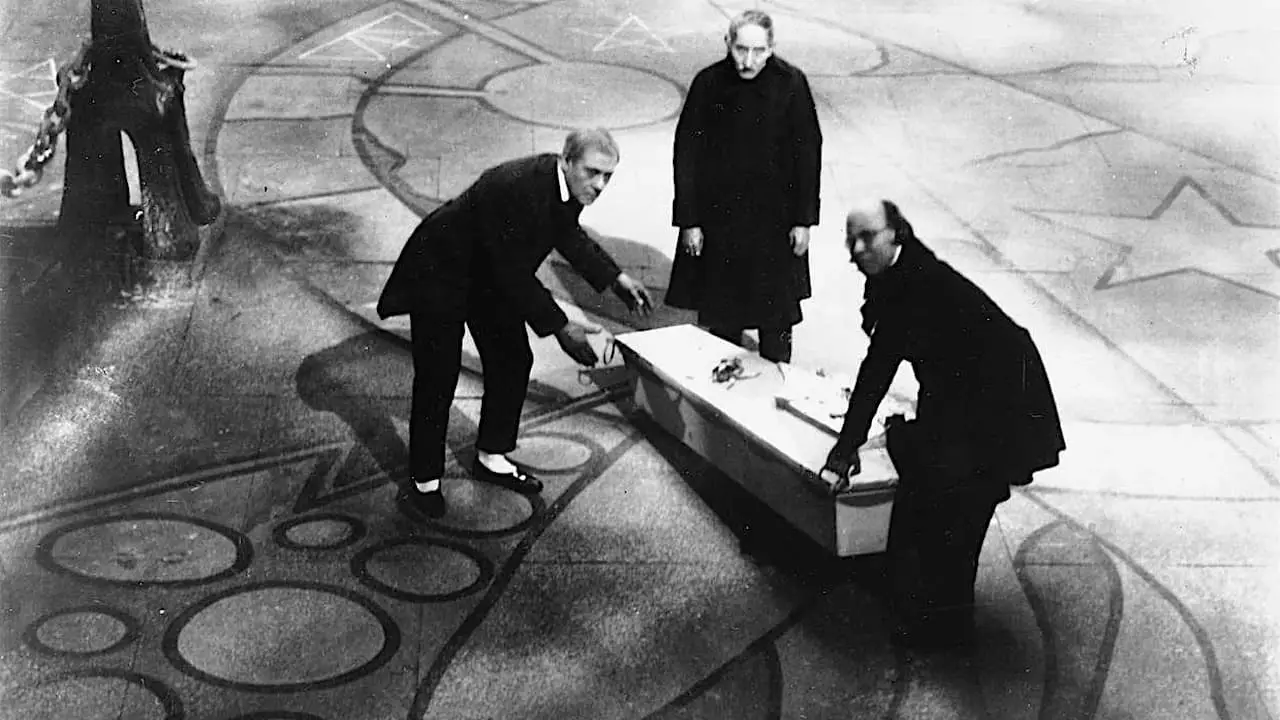
How to Turn Edgar Allan Poe into a Goth Fever Dream with Slow-Mo Candles and a Killer Modern Dark Ambient Score
It’s 3:15 AM. My eyes feel like they’ve been rubbed with coarse sandpaper, the cold pizza on my desk is starting to look back at me, and I am currently witnessing a gorgeous, avant-garde, slow-motion shot of a white bridal veil floating down a dark, misty castle corridor while a haunting, modern drone-synth score by Floyd Pientka vibrates my eardrums and makes me feel like my room is actively haunted.
Welcome, my friends, to the hypnotic, hallucinatory, and deeply Gothic world of Jean Epstein.
If you’ve never heard of Jean Epstein’s The Fall of the House of Usher (La Chute de la maison Usher), congratulations: your local goth club hasn’t recruited you yet. For the uninitiated, this French silent film is widely considered one of the greatest Edgar Allan Poe adaptations ever captured on celluloid. Epstein’s filmmaking method was a masterclass in French Impressionist poetry:
- Don’t just adapt “The Fall of the House of Usher”—smash it together with another Poe story, “The Oval Portrait,” so you have a plot about a man literally painting his wife’s life force onto a canvas.
- Get into a massive, screaming argument with your co-writer—who happened to be a young Luis Buñuel—because he thinks you are disrespecting Poe’s text, causing him to storm off the set and call you a “petty bourgeois.”
- Film everything in slow-motion, use dizzying triple-exposures, and capture blowing curtains, dripping wax, and falling leaves with such hypnotic beauty that you basically invent the visual grammar for every goth rock music video of the 1980s.
The result? The Fall of the House of Usher (1928), specifically elevated by Floyd Pientka’s brilliant 2022 custom music score.
The “Plot” (If we can even call it that)
Allan travels to the gloomy, fog-covered Usher estate to visit his eccentric friend, Roderick Usher. Roderick lives in a decaying, massive mansion with his sickly wife, Madeline. Roderick is obsessively painting a portrait of Madeline, but there’s a terrible, supernatural catch: every time he puts his brush to the canvas, the painting gets more lifelike, while the real Madeline grows weaker. He is literally sucking her soul out through his paintbrush.
Madeline eventually collapses and “dies.” Roderick, in a state of absolute, guitar-string-tension denial, refuses to believe she is gone. They put her in a coffin in the family crypt, but—surprise, surprise—she might not actually be dead. As a massive storm hits the mansion, the house itself decides it has had enough of the Usher family drama and begins to literally tear itself apart.
It is a slow, deeply psychological, and incredibly atmospheric trip down a rabbit hole of grief, madness, and very high-contrast shadows.
Why You Need to Watch This Tonight
- The Floyd Pientka 2022 Score: Let’s talk about the specific elephant in the room. Watching silent films with the original, dusty, ragtime piano tracks can sometimes take you out of the spooky mood. Floyd Pientka’s 2022 score replaces that with a modern, eerie, dark ambient/acoustic soundscape. It adds a thick layer of modern, dread-inducing tension that matches Epstein’s hallucinatory visuals so perfectly you’ll forget the movie was made nearly a century ago.
- The “Goth Music Video” Aesthetic: Jean Epstein was obsessed with the texture of film. The way he shoots wind blowing through a giant, empty room, or Roderick Usher playing a lute in a room full of candles, is breathtakingly beautiful. It has a raw, dreamlike quality that looks like a high-budget, black-and-white art-house horror film made today.
- The Buñuel Backstage Drama: The fact that Luis Buñuel (the surrealist genius behind Robinson Crusoe and Un Chien Andalou) worked on this script but quit because he thought Epstein’s vision was too romantic is fantastic. You can still feel some of that surrealist, unsettling energy in the film’s weirdest camera angles.
- The Shaking Camera and Falling Books: In the film’s chaotic climax, Epstein literally shook the camera, double-exposed the collapsing walls, and slid books off shelves in slow motion to simulate the house falling apart. It is a brilliant, low-tech masterpiece of practical effects that feels incredibly chaotic.
The Verdict
Is it a good movie? It is an absolute masterpiece of silent-era art. It doesn’t rely on cheap jump scares; it relies on a heavy, suffocating, and beautiful atmosphere that slowly wraps around your throat. When paired with the modern English intertitles and Floyd Pientka’s haunting, drone-heavy 2022 score, it is the absolute perfect late-night watch for a rainy, dark evening.
My Rating: 5 out of 5 slow-motion dripping candles that symbolize the decay of human sanity.
Wanna see a silent-era gothic dream brought to life with a killer modern soundtrack?
Turn off all the lights in your house, put on your best headphones to fully appreciate Pientka’s deep, rumbling 2022 ambient score, and search for this specific restored version on your favorite public domain video platform. Because the original 1928 film is in the public domain, you can experience this historic French masterpiece completely free and legally.
[WATCH “THE FALL OF THE HOUSE OF USHER (1928)” ON YOUTUBE (Opens in a new window)]