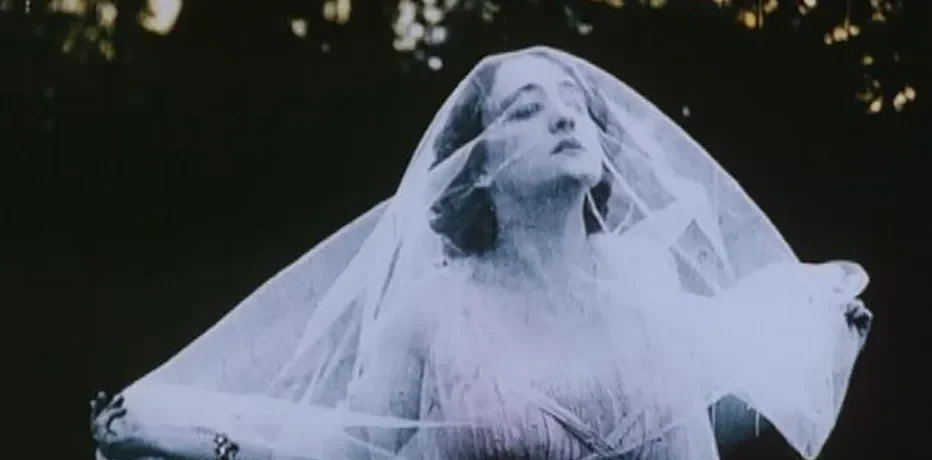
How to Sell Your Soul for Youth, Wear Mind-Blowing Art Nouveau Gowns, and Invent “Diva-Core”
It’s 3:15 AM. My eyes feel like they’ve been rubbed with coarse sandpaper, the cold pizza on my desk is starting to look back at me, and I am currently watching the legendary Italian silent-era diva Lyda Borelli, draped in a shimmering, hand-colored, butterfly-sleeved gown, dramatically clutching her throat and leaning against a marble pillar in a state of absolute, operatic despair because she accidentally fell in love and is turning back into an old lady.
Welcome, my friends, to the gorgeous, hand-painted, and fabulously overdramatic world of Italian “diva” cinema.
If you’ve never heard of Rapsodia Satanica (Satan’s Rhapsody), congratulations: your wardrobe has never been threatened by the sheer, high-fashion dominance of early 20th-century European design. For the uninitiated, this 1917 silent film is a female variation of the classic Faust legend. The director, Nino Oxilia (a brilliant young poet who tragically died in World War I shortly after finishing the film), had a simple, highly aesthetic, and deeply romantic strategy:
- Cast Lyda Borelli—the undisputed queen of “borellismo” (a highly stylized, slow-motion, hand-waving acting craze that had Italian women literally copying her dramatic poses in front of their mirrors).
- Dress her in stunning, flowing Art Nouveau gowns designed by the legendary Mariano Fortuny.
- Skip the black-and-white look and have a team of artists meticulously color every single frame of the film by hand using stencils (pochoir), creating a soft, dreamlike pastel palette.
The result? Rapsodia Satanica (1917).
The “Plot” (If we can even call it that)
Dame Alba d’Oltrevita (Lyda Borelli) is an elderly, incredibly wealthy aristocrat who lives in a massive, castle-like estate. She is deeply depressed because her youth is gone. Suddenly, Mephistopheles (Satan) pops out of a mirror. He doesn’t have a pitchfork; he is a dapper, top-hat-wearing gentleman who looks like he’s about to invite her to a fancy dinner.
Satan offers her a deal: he will restore her youth and beauty, but on one condition—she must never fall in love. Alba eagerly signs the pact, immediately turns into a stunning young woman, and begins to wander through her gardens like a wood nymph.
But then, two wealthy brothers, Tristano and Sergio, show up. Both fall madly in love with her. Tristano is sweet, but Sergio is an angsty poet who threatens to shoot himself if Alba doesn’t return his love. Alba, trying to protect her youth, rejects Sergio. He actually goes through with it, and the shock of his death breaks her pact with Satan. She slowly morphs back into a withered old woman and dies in her empty mansion.
It is a short, 45-minute gothic tragedy that is essentially a high-fashion music video about the vanity of youth.
Why You Need to Watch This Tonight
- The Mind-Blowing Stencil Coloring: This is not a boring, grainy black-and-white film. The pochoir coloring process gives the movie a shimmering, pastel-toned, fairytale aesthetic. The soft pinks of the gardens, the deep blues of the night scenes, and the shimmering golds of Alba’s dresses make the entire film look like a moving watercolor painting.
- Lyda Borelli’s Peak “Diva” Acting: Borelli doesn’t just act; she performs a continuous, slow-motion, operatic dance. She wraps herself in silk veils, clutches her forehead, twists her body around stone pillars, and peers through her fingers with intense, heavy-lidded longing. It is a style of acting that is so beautifully, hilariously theatrical it makes modern actors look like they are standing still.
- The Custom Operatic Score: The legendary Italian opera composer Pietro Mascagni (the guy who wrote Cavalleria rusticana) was commissioned to write a custom, synchronized orchestral score for the film. It is one of the very first times a major composer wrote a custom score for a movie, and it turns the film into a booming, tragic, and deeply emotional operatic experience.
- The Dapper, Mirror-Dwelling Satan: The portrayal of Mephistopheles is fantastic. He is a mischievous, top-hat-wearing trickster who casually sits on the arms of chairs, pops in and out of mirrors, and smiles at Alba’s tragic mistakes like a smug, unwanted houseguest.
The Verdict
Is it a good movie? It is an absolute, jaw-dropping visual masterpiece. It is the definitive peak of the Italian Art Nouveau (Stile Liberty) movement, and a stunning tribute to the power of silent-screen presence. It is short, it is tragic, and every single frame of the film is beautiful enough to be hung in an art gallery.
My Rating: 4 out of 5 hand-painted silk veils dramatically thrown into a lake.
Wanna see a silent-era gothic tragedy colored like a dream?
Turn off all the lights, put on some good speakers to appreciate Mascagni’s booming, romantic orchestral score, and search for this restored, hand-colored Italian classic on your favorite retro cinema or archive platform. Because it was made over a century ago, this entire, gorgeous, 45-minute fashion-fever-dream is completely free and legally available for you to watch whenever you want.
[WATCH “RAPSODIA SATANICA (1917)” ON YOUTUBE (Opens in a new window)]