How to Suffer the Worst Luck in Hollywood, Get Blackmailed by a Screeching Harpy, and Commit the Most Absurd Phone-Cord Murder in History
It’s 3:15 AM. My eyes feel like they’ve been rubbed with coarse sandpaper, the cold pizza on my desk is starting to look back at me, and I am currently watching a sweat-drenched, completely defeated piano player in a diner staring into a cup of black coffee while his internal monologue tells me about “fate, or some mysterious force” that has doomed him, while a woman in a cheap coat screams at him to shut up and buy her another drink.
Welcome, my friends, to the grim, sweaty, and beautifully cheap world of Poverty Row noir.
If you’ve never watched Detour, congratulations: you’ve only watched big-budget, glossy Hollywood thrillers and missed out on the ultimate, masterpiece-on-a-shoestring film noir. The director, Edgar G. Ulmer (the undisputed king of low-budget cinema), had a simple, highly claustrophobic, and incredibly fast-paced strategy:
- Shoot an entire movie in just six days for about $20,000 to $30,000 for Producers Releasing Corporation (PRC)—a studio so cheap their logo was basically drawn with a crayon.
- Use a massive fog machine inside a tiny, empty studio corner to hide the fact that you don’t have the budget to shoot on an actual desert highway.
- Turn a simple hitchhiking trip into a psychological nightmare about a guy who makes the absolute worst, most panic-induced decision at every single junction.
The result? Detour (1945).
The “Plot” (If we can even call it that)
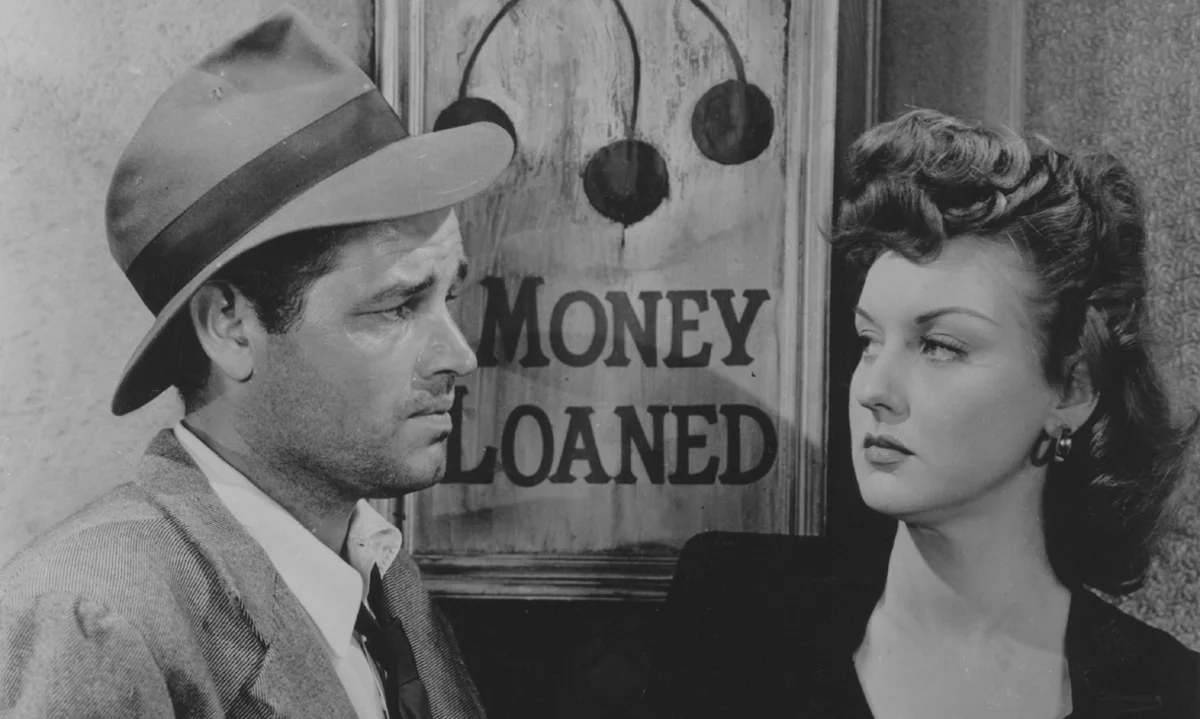
Al Roberts (Tom Neal) is a broke, depressing nightclub pianist in New York who decides to hitchhike to Los Angeles to marry his singer girlfriend, Sue. He gets picked up in Arizona by a wealthy, flashy guy named Charles Haskell Jr. During the drive, Haskell suddenly and unexpectedly dies of a heart attack in the passenger seat.
Fearing the police will accuse him of murder (because Al has the self-preservation instincts of a confused puppy), Al hides Haskell’s body in the brush, steals his clothes, steals his wallet, and takes over his car and identity.
But then, Al makes the fatal mistake of picking up a hitchhiker named Vera (Ann Savage). Unfortunately for Al, Vera was picked up by the real Haskell just a few days earlier. She immediately realizes Al is an impostor, takes his car keys, and turns his life into an absolute, living hell of blackmail, screeching demands, and existential dread.
Why You Need to Watch This Tonight
- The Terrifying Viciousness of Ann Savage: Vera is not your typical, seductive, smooth-talking femme fatale. She is a venomous, screeching harpy who does not flirt; she demands. She spends the entire movie screaming at Al, coughing like she has tuberculosis, drinking cheap whiskey, and treating him like absolute dirt. She is a force of nature, and her performance is one of the most memorable and terrifying in all of noir history.
- The Most Absurd “Accidental” Murder in Cinema: The climax of the film is legendary. During a massive argument in a cheap motel, a drunk Vera locks herself in the bedroom to call the police. Al, standing on the other side of the locked door, grabs the telephone cord sticking out from under the door frame and pulls on it to rip the phone out of the wall. Unbeknownst to him, the cord has somehow wrapped perfectly around Vera’s neck, and he accidentally strangles her to death. It is the most bizarre, “only-could-happen-to-this-guy” accident ever filmed.
- The Poverty Row Filmmaking Hacks: Because PRC had no money, Edgar G. Ulmer had to get incredibly creative. To save money on gas and cars, they used the same vehicle and literally flipped the film negative during editing to make it look like they were driving in a different direction (which is why the steering wheel suddenly jumps to the right side of the car in some shots).
- The Suffocating Nightmare Atmosphere: The microscopic budget actually works in the film’s favor. The heavy fog, the cheap rear projection of looping roads, and the intense close-ups on Tom Neal’s sweating, desperate face make the entire 68-minute movie feel like a fever dream about running out of time.
The Verdict
Is it a good movie? It is a flat-out masterpiece of existential dread. It was the first B-movie in history to be selected by the Library of Congress for preservation in the National Film Registry, and at a brisk 68 minutes long, it is a non-stop, gripping, and wildly entertaining ride. It proves that you don’t need millions of dollars, fancy sets, or a big studio to create a timeless, gripping thriller—just a fog machine, a telephone cord, and a really angry woman.
My Rating: 5 out of 5 telephone cords accidentally pulled through a locked door.
Wanna see the ultimate, low-budget masterpiece of existential dread?
Turn off your phone, dim the lights, and search for this Poverty Row classic on your favorite retro cinema or B-movie platform. Because it has slipped into the public domain, you can watch Tom Neal make the worst decisions of his life completely free and legally.
WATCH “DETOUR (1945)” ON YOUTUBE (Opens in a new window)]