How to Start a Communist Revolution with Rotten Meat, a Baby Carriage, and Some Serious Editing Flex
It’s 3:15 AM. My eyes feel like they’ve been rubbed with coarse sandpaper, the cold pizza on my desk is starting to look back at me, and I am currently watching a bunch of angry Russian sailors throw a ship’s doctor into the ocean because he tried to convince them that the crawling maggots in their soup were actually just “harmless fly larvae.”
Welcome, my friends, to the high-energy, politically charged, and visually explosive world of Sergei Eisenstein.
If you’ve never heard of Eisenstein, congratulations: you’ve never had to suffer through a film school lecture. For the uninitiated, this Soviet director is the undisputed godfather of modern film editing. His filmmaking method—which he called “Soviet Montage”—was simple but terrifyingly effective:
- Don’t worry about deep character development or individual hero arcs. The “hero” is the angry mob.
- Smash completely different images together at lightning speed to trigger a physical reaction in the viewer’s brain.
- Edit the film so aggressively that the audience gets a dopamine hit and suddenly feels a strong, overwhelming urge to go outside and overthrow their local government.
The result? Battleship Potemkin (1925).
The “Plot” (If we can even call it that)
It is 1905. The sailors on the Russian battleship Potemkin are sick of being treated like garbage. The tipping point? The officers try to force them to eat meat that is practically walking on its own. The sailors mutiny, kill the officers, and sail the ship to the city of Odessa, where the local citizens welcome them as heroes.
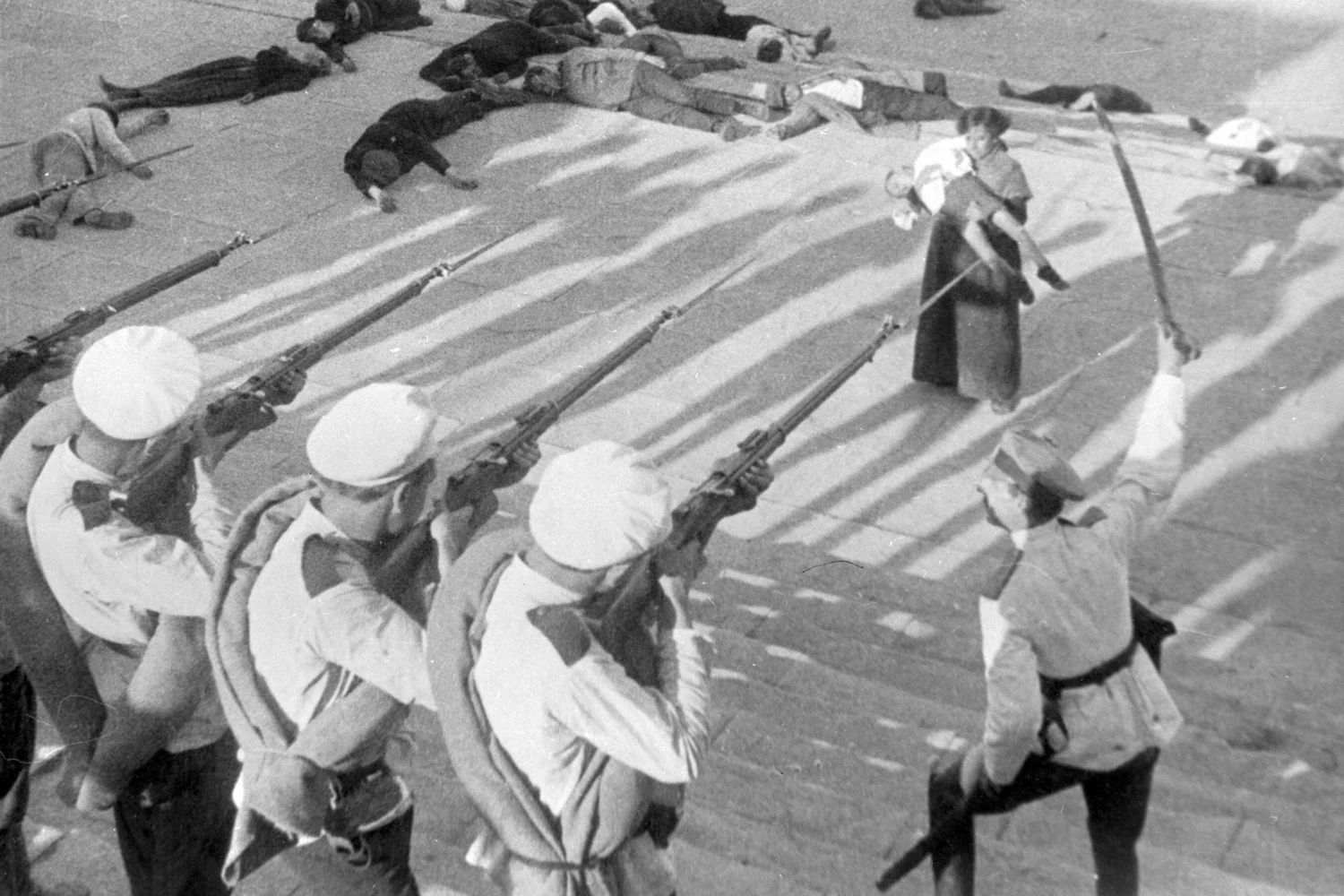
But then the Tsar’s soldiers march in with rifles, and things go downhill very, very quickly on a giant set of stone steps.
There are no complex subplots or romantic triangles here. It is pure, raw, ideological adrenaline. It is essentially a 75-minute-long hype video for the working class, dressed up as a historical drama.
Why You Need to Watch This Tonight
- The Maggot Magnifying Glass: Early in the film, the ship’s doctor inspects the rotting meat with a magnifying glass. The extreme close-up of the wriggling maggots is so gross it still works perfectly today. The doctor’s absolute denial of reality is a masterclass in middle-management gaslighting.
- The Odessa Steps Sequence: This is the absolute blueprint for every action movie sequence you have ever seen. If you’ve watched the train station shootout in The Untouchables, or the parodies in The Simpsons, you’ve seen this scene. The boots marching, the screaming faces, and, of course, the legendary baby carriage rolling down the steps out of control—it is pure cinematic anxiety.
- The Angry Stone Lions: To show the city of Odessa “waking up” in anger, Eisenstein edits three different shots of stone lion statues together: one sleeping, one waking up, and one roaring. It is a massive editing flex that has no logical business being in the movie, but it looks incredibly cool.
- The Ban List: This movie was so effective at hyping up crowds that it was banned in several countries, including Germany, France, and the UK, for decades. Authorities were genuinely terrified that showing it would start actual, real-life worker riots in the streets. That is some serious heavy-metal energy for a silent movie.
The Verdict
Is it a good movie? It is a masterpiece. Even if you don’t care about 100-year-old Soviet politics, the pacing and the visual storytelling are better than most modern action blockbusters. It is short, incredibly violent for its time, and moves like a freight train.
My Rating: 5 out of 5 rolling baby carriages that you desperately want to catch but can only watch in horror.
Wanna see where modern action editing was born?
Dim the lights, put on some heavy synthwave music in the background (trust me, it pairs incredibly well with Soviet silent cinema), and go search for this classic on your favorite public domain video platform. Since the copyright expired decades ago, it is completely free and waiting for you to discover it.
[WATCH “BATTLESHIP POTEMKIN (1925)” ON YOUTUBE (Opens in a new window)]